Guided Entry
A chamfered tip guides the tool into the pre-drilled hole.

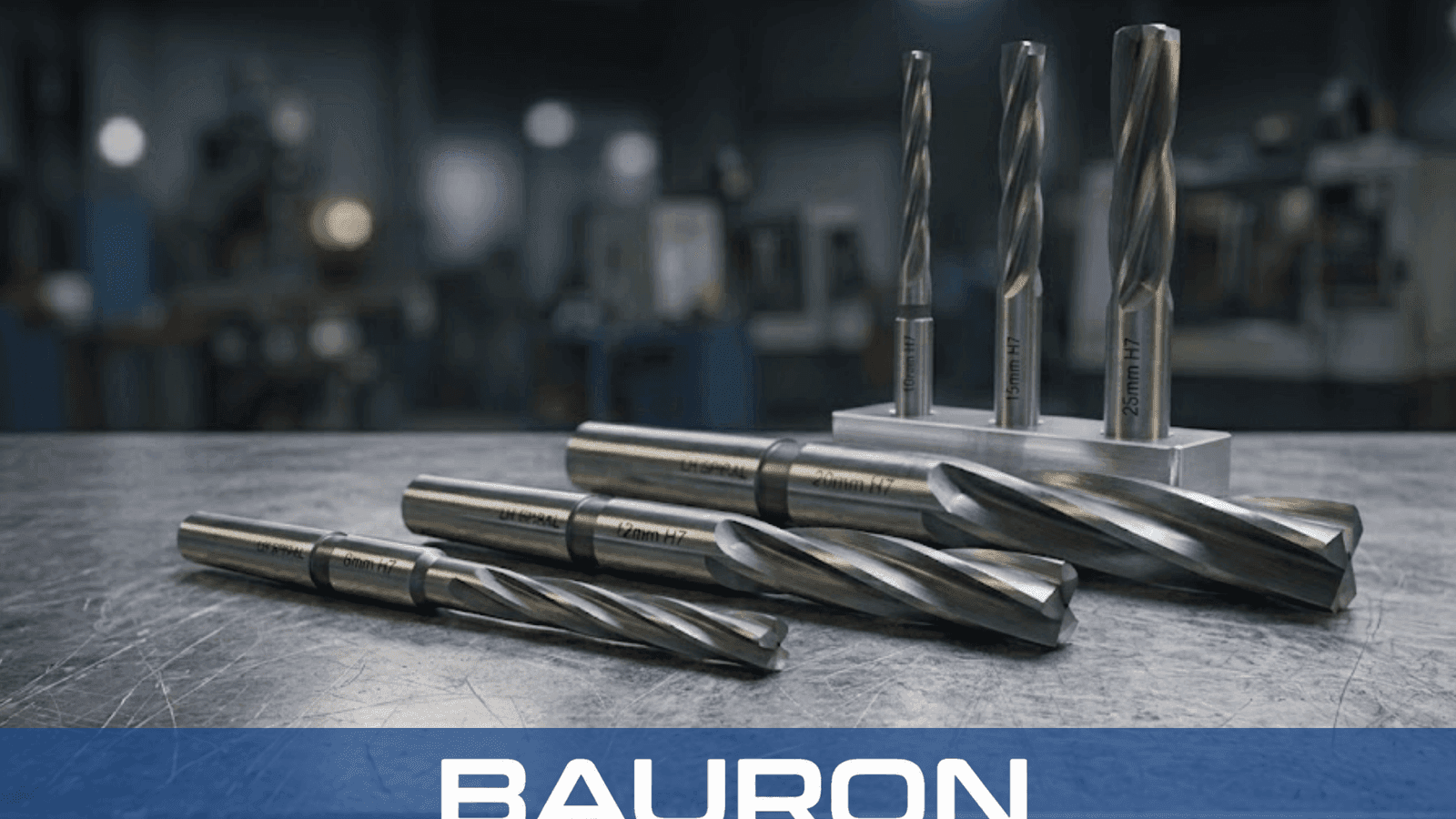
A left-hand spiral reamer sizes through-holes, including work in materials prone to grabbing. Its left-hand spiral and right-hand cut support controlled finishing by pushing chips ahead of the tool and resisting aggressive self-feeding.
A chamfered tip guides the tool into the pre-drilled hole.
Right-hand rotation progressively shears material from the inner walls.
Left-hand spiral flutes push chips ahead of the tool.
Continuous shearing supports a smooth, precise internal diameter.
Pushes chips forward to help protect the finished surface from scratching.
Works with standard clockwise spindle rotation.
Helps prevent self-feeding or grabbing into the workpiece.
Distribute cutting forces around the bore to support accuracy and reduced chatter.
Support tight dimensional tolerances and a fine surface finish.
Supports secure clamping in CNC chucks or hand-reaming wrenches.
| Specification | Range / Details |
|---|---|
| Diameter Range | 1/16" to 2"; standard and metric sizes available |
| Flute Geometry | Left-hand spiral, right-hand cut |
| Number of Flutes | 4 to 8, depending on diameter |
| Shank Type | Straight, Morse taper, or square end |
| Tolerance | H7 standard or custom precision-ground |
| Operation Type | Through-holes |
| Material / Coating | Best For | Key Advantage |
|---|---|---|
| HSS (High-Speed Steel) | Mild steel, aluminum, and general-purpose through-holes. | An economical option with toughness for standard production. |
| Solid Carbide | High-volume production on abrasive or very hard alloys. | Provides high rigidity and extended wear life. |
| TiCN Coating | Sticky materials such as stainless steel or cast iron. | Reduces friction and helps limit edge buildup. |
HSS provides toughness for general through-hole work, solid carbide supports rigid high-volume machining, and TiCN can reduce friction in sticky or abrasive workpiece materials.
Use rigid holders for automated through-hole finishing.
Support tailstock or turret operations on stationary or rotating cylindrical parts.
Provide controlled vertical reaming with manual or automatic feed.
Drive square-shank versions for controlled hand reaming.
Pushes chips forward to help prevent them from scoring the newly finished bore.
Bridges gaps such as keyways or cross-holes with reduced risk of catching.
The negative axial rake helps limit grabbing in tough alloys that can bind straight-flute reamers.
Provides gradual cutting pressure when used as a spiral hand-reaming tool during assembly.
A left-hand spiral reamer pushes chips forward and resists self-feeding, making it suited to interrupted cuts and through-holes. A straight-flute reamer has parallel flutes and is generally used for standard, non-interrupted holes.
It should generally not be used for blind holes because the flute direction pushes chips toward the bottom, where packing can damage the tool, surface, or workpiece.
The right-hand cut runs with standard clockwise spindle rotation. The left-hand spiral creates a negative axial rake that resists the feed direction and helps prevent sudden grabbing.
The source recommends cobalt HSS or solid carbide. The spiral geometry bridges the interruption, while the harder substrate helps the cutting edges withstand repeated impacts.
Bauron can manufacture custom diameters, shank lengths, tolerances, and coating configurations to match blueprint requirements.
Bauron provides design and engineering support for custom geometries, coatings, diameters, shank lengths, and tolerances. Share the application and blueprint requirements for technical review.
Talk to Engineering